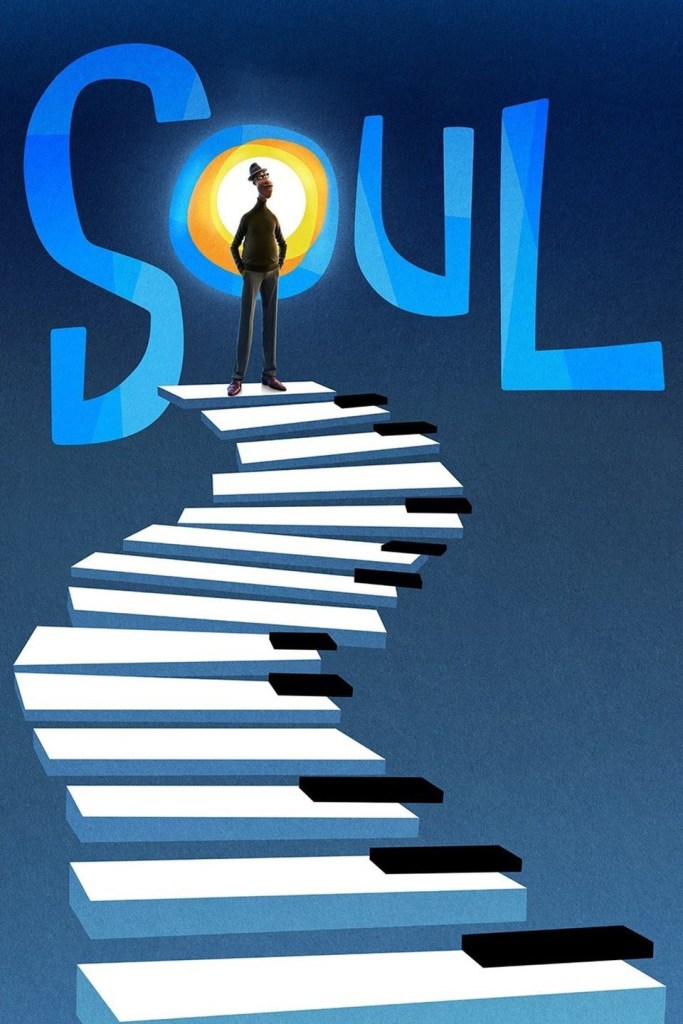
I put aside this post as a draft for longer than I would like to admit. I started blogging with a goal of publishing at least one post per month, but alas, three months have passed since I’ve published anything here. Today is the last day of a new year. This month we welcomed a new Administration and reached a new milestone in public health–two highly effective COVID-19 vaccines have rolled out and been distributed beyond health-care workers. Due to a second wave of COVID in NYC, I have been swamped with work that has demanded a lot of overtime, giving me a little to no headspace and leisure to write at all in the past couple of months. Despite the hectic schedule, I squeezed in some film viewing. My family and I streamed Soul on Disney+ the day after it premiered on Christmas. I enjoyed it and have been working on this critique bit by bit since.
This was the only movie I looked forward to all year long. With the theaters being temporarily closed, I’ve found it harder to stay up-to-date with movies because I usually rely on trailers in the theater for what to expect and look out for. Going to the movies was one of my regular diversions pre-COVID, and I can’t wait to get back to it once the epidemic is lifted. Until then, street posters and previews on streaming services will do.
While the movie has received a generally positive reception, it garnered unfavorable reviews concerned with its racist implications. Some audiences who were hopeful about the movie featuring a Black man as the protagonist have expressed disappointment in the human character’s transformation into a quasi-dead soul, failing to amplify the authentic voice of a minority group (https://www.tor.com/2020/07/14/representation-without-transformation-can-hollywood-stop-changing-cartoon-characters-of-color/). The dissenters have a point. More movies with people of color as leading roles that do not turn into amorphous or zoomorphic characters cannot wait. However, Pixar delivered yet again–real, relatable characters, accurate depictions of the setting, and ontological dialogues and themes that deserve more credit and praise than criticism.
*Disclaimer- spoilers beyond this point*
The movie is about a high school band teacher named Joe Gardner who loves to perform Jazz piano in Harlem of New York City. In the beginning we find him jaded after many failed auditions and barely holding his class band together. One day he meets a famous saxophonist named Dorothea Williams and dazzles her with his piano playing. Dorothea gives Joe a chance to perform with her quartet band at the Half Note Club. Joe is overjoyed and determined not to throw away his shot at redeeming his performance career. While he ecstatically calls up his friends about the good news, Joe falls into a manhole and wakes up as a soul en route to the Great Beyond—the afterlife or post-existence place of life, whichever you want to take.
He is not quite dead yet. His body is in a coma in the hospital, while his soul is pending for a subsequent life of uncertainty. Death right before getting closer to achieving one’s dream—sheer misfortune or fate? Joe refuses to leave his life behind on Earth and desperately tries to return home to make it to the gig. He accidentally lands on the Great Before where unborn souls are preparing for their lives as humans with mentors who already completed their time on Earth. Here enter Soul 22, a precocious and nihilistic being who have spent thousands of years figuring out their “spark,” the last badge along with inherent personality traits needed to debut their life as a human. Soul 22 have had many mentors including notable historical figures such as Mother Teresa, Carl Jung, Abraham Lincoln, and Marie Antoinette, but none of them succeeded in helping Soul 22 graduate from the Great Before. Joe decides to mentor Soul 22 in exchange for returning home and reuniting with his body.
Joe and Soul 22 descend from the Great Before and land in New York City. Joe wakes up to realize that his soul entered a therapy cat in the hospital while Soul 22 ended up in his body. The real Joe, now a cat, and Soul 22, who begrudgingly pretends as Joe, go on an adventure in the city. At first, Soul 22 as Joe refuse to cooperate with the real Joe in reclaiming his original body and try to get away. Joe bribes 22 with a slice of New York pizza. Soul 22 is enlightened by such delectable experience. As 22 live the life of Joe and meet the people in his life, Soul 22 learn that life is made of strange and joyful experiences. 22 have spent numerous years trying out various activities in the Hall of Everything to determine their purpose. They eventually earn their last badge after a brief trial of living on Earth through Joe, but neither the audience or the characters know what exactly ignited their spark. When Joe asks the Great Before counselor Jerry what 22’s spark was, Jerry laughs and tells him that a soul does not have a specific purpose.
The main takeaway of Soul is that life is more than careers or achievements–it’s about gaining experiences and taking pleasure in small, ordinary moments. Joe thought music was his spark his entire life and that his gig with Dorothea Williams would advance his course as a musician, but after the performance, he doesn’t feel as elated or gratified as he anticipated. Dorothea then tells him a story about a fish in the ocean:
“[A fish] swims up to an older fish and says: ‘I’m trying to find this thing they call the ocean.’ ‘The ocean?’ the older fish says, ‘that’s what you’re in right now.’ ‘This’, says the young fish, ‘this is water. What I want is the ocean!’”
Like the young fish, Joe has constantly strived for something bigger and better, but after a near-death experience, mentoring a lost soul and being trapped in a cat’s body, Joe learns to appreciate and celebrate the moment and small wins. I was also guilty of being shortsighted as the young fish when I just left the Centers for Disease Control and Prevention. I was certain that I would find a full-time job in clinical research right away, but it took me seven months of working part-time at a retail chain coffeeshop and a total of one year of applying and doing interviews until I secured my current position at a local health department. I thought I had all the variables, a Master’s degree from a reputable program and prior research experiences, needed to be employed. Even after an interview I thought went well and felt good about, the company never got back to me. With hindsight, I am grateful for that season in my life when I was serving and working with people through coffee. More about that later in a future post.
I think most of us are like Joe in a sense that we don’t appreciate the value of our lives until a near-death experience first-hand or indirectly through a loved one. I had this existential moment when a car almost hit me as I was crossing the road during an afternoon run two years ago. It was my right of way, but the car kept going despite the light that had just turned red. The impenitent driver honked at me. I made it to the other side safely in one piece but froze for a few seconds. It felt as if everything around me paused. I thought of my friend’s friend who had just passed away from the Sri Lanka bombings earlier that month. I thought to myself, “Wow, that was close. If the car hit me, I would have been in a critical condition or died.” I was relieved and grateful for my life.
If you were to die today and replay the life you’ve had as you prepare for the Great Beyond, what images would you see? Were you good? Were you kind? Were you strong? What did you do? To the very end, did you try to enjoy the moment to the fullest? As poet Mary Oliver put it, “Tell me, what is it you plan to do/ with your one wild and precious life?”
 the renaissance woman